If you took Geology BRCC last year, please click on the link to this survey and fill it out. It will help me out a great deal of you will answer the questions with some detail (thoughtfully and more than just a sentence :)).
Have a great Christmas!
Friday, December 16, 2011

Thursday, December 15, 2011
A New Blog From Mr. Kohrs
Throughout the school year, I receive/entertain a great many questions from many of you on matters of the intersection between science and faith. I try to be careful in discussing these with you, as I do have certain ethical boundaries to which I must adhere as your teacher. I can, however, freely talk about myself and my personal beliefs if asked and if I deem it is appropriate. I thank you for those opportunities and will always be careful to tread lightly in these areas.
It is in this vein that I choose to share with you a new project that I am embarking upon that will explore the boundary, or confluence, between science and faith. It will be a little more personal on my part at times, but educational as well. My goal is to explore ways in which science and faith can be brought together. In our culture, particularly amongst Christians here in the USA (as it really isn't an issue outside of the USA), there is a great deal of conflict in this area. As a result, science and faith are usually thought of as mutually exclusive, where one cannot coexist with the other.
I reject this proposition whole-heartedly. As a scientist and a Christian, I see no need for conflict. Anyway, check out General Revelations if you are interested in reading any further...
It is in this vein that I choose to share with you a new project that I am embarking upon that will explore the boundary, or confluence, between science and faith. It will be a little more personal on my part at times, but educational as well. My goal is to explore ways in which science and faith can be brought together. In our culture, particularly amongst Christians here in the USA (as it really isn't an issue outside of the USA), there is a great deal of conflict in this area. As a result, science and faith are usually thought of as mutually exclusive, where one cannot coexist with the other.
I reject this proposition whole-heartedly. As a scientist and a Christian, I see no need for conflict. Anyway, check out General Revelations if you are interested in reading any further...
Wednesday, October 19, 2011
Green River Formation Fossils
Lagerstatten, varves, marlstones...whuh???
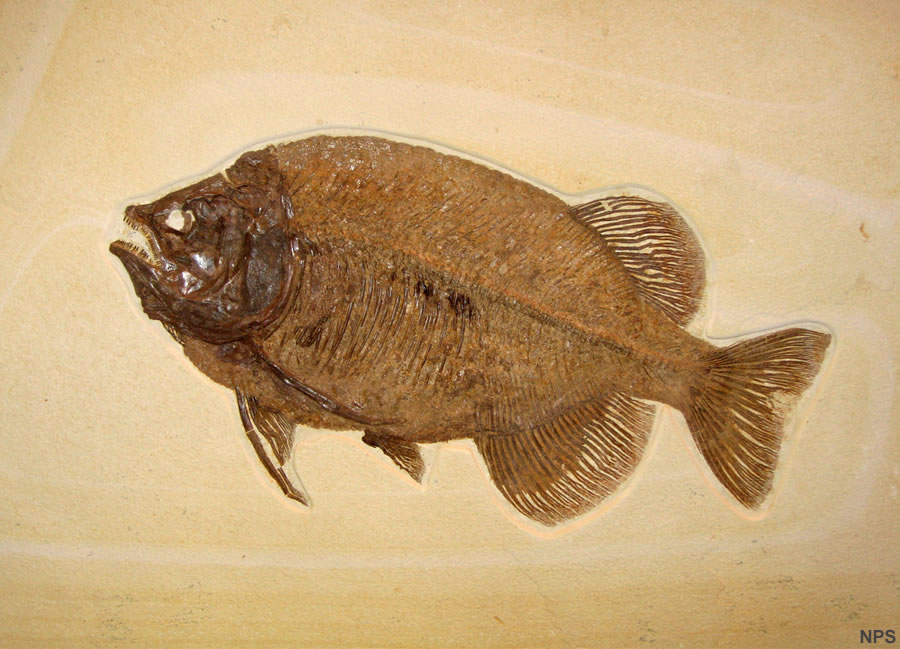
Yes! These are strange words, but fitting for a rock formation that contains such unusual fossil specimens. You can find the definitions of these words by reading this article on the Green river Formation here. You may also want to check it out just to see the amazing pictures of fossil lagerstatte, or exceptionally well-preserved fossils. These truly are exceptional!
The Green River Formation is known for its coals and oil shales, not just its fossils, but 50 million years ago, when the Rockies were young, it was deposited as muds and silts eroded down the sides of these newly minted mountains and deposited in intermountain basin lakes. It was warm and humid though, even in this environment, which allowed for copious amounts of vegetation to thrive as well as a very diverse portfolio of animals and insects.
Yes! These are strange words, but fitting for a rock formation that contains such unusual fossil specimens. You can find the definitions of these words by reading this article on the Green river Formation here. You may also want to check it out just to see the amazing pictures of fossil lagerstatte, or exceptionally well-preserved fossils. These truly are exceptional!
The Green River Formation is known for its coals and oil shales, not just its fossils, but 50 million years ago, when the Rockies were young, it was deposited as muds and silts eroded down the sides of these newly minted mountains and deposited in intermountain basin lakes. It was warm and humid though, even in this environment, which allowed for copious amounts of vegetation to thrive as well as a very diverse portfolio of animals and insects.
Monday, October 17, 2011
Geology BRCC Work This Week
Hello BRCC'ers! I have posted this week's notes on Running Water, Chapter 16 in your text, in the links section on this page. On Wednesday, we will explore the work and behavior of rivers and streams as they sculpt the landscape!
On Friday, we will be in the computer lab exploring fluvial dynamics and flooding by using Virtual River, an online interactive exploration that I think you will find challenging and interesting. There are two certificates to print at the end of each activity, one for River Discharge, the other for River Flooding.
Enjoy! Have fun at the FFA conference!
On Friday, we will be in the computer lab exploring fluvial dynamics and flooding by using Virtual River, an online interactive exploration that I think you will find challenging and interesting. There are two certificates to print at the end of each activity, one for River Discharge, the other for River Flooding.
Enjoy! Have fun at the FFA conference!
Wednesday, September 28, 2011
Remote Sensing of Groundwater -- Wow!!

Wow! NASA, ESA, and Italian space agency scientists have developed a low frequency radar technology that can penetrate a planet's crust in order to map aquifers of liquid water. Currently, this technology is being used to map the Martian subsurface to a depth approaching 2km. So far, only water ice has been detected. However, the same technology has been used to map fossil, or ancient, aquifers in the Kuwaiti desert. The societal implications of this technology are far-reaching, as groundwater prospecting promises to become much more lucrative as global population increases, especially in those arid areas bordered, or contained, within deserts.
Whether or not this technology gains widespread use here on earth, the results from the Kuwaiti aquifer survey will help scientists enhance their interpretation of Martian subsurface data. Great stuff!
Friday, August 26, 2011
A Planet Made of Diamond? And Orbiting a Pulsar!!!
Credit: Reuters
Wow! Be sure to read this captivating story about a planet in our galactic backyard that appears to be made of densely packed carbon. Certainly, some of this planet consists of diamond.
What's more, this planet is orbiting a pulsar. Go PSC (see below). So, scientists have been able to learn some interesting things from it.
Thursday, August 18, 2011
Welcome Back!!!!!!
I hope that you have had a great summer full of fun and I hope that you may have learned something new as well!
This is a year of regeneration for astronomy, geology, and geology BRCC. Read here for some upcoming highlights for the 2010-2011 school year:
Geology -- We will be integrating some use of ArcView GIS when possible into classroom instruction. This is really great because GIS is used in industry and science a great deal and is also a promising, high-paying career path for those with an interest in computers, science, and geography. Otherwise, we will continue exploring the basics of traditional physical geology in both the classroom and through a variety of short and long field trips.
Geology BRCC -- You will be heavily introduced to GIS this year in the context of physical geology. Read above for more information on that, but we will be conducting a study to see if we can identify good sites to drill a large production groundwater well in the Broadway area. Last year, we focused on hydrofracking in Bergton, VA and that study is still available for viewing online.
Astronomy -- See the logo below? Broadway High School is now a member school in the Pulsar Search Collaboratory, a collaboration between the National Radio Astronomy Observatory and West Virginia University -- and now BHS! Several BHS students traveled to Green Bank, WV this summer to learn how to analyze and search for new, unknown pulsars using drift scan Green Bank Telescope data. All of you will receive the training and take the first test to do this also. However, you can then choose whether or not to take the second test and become a member of the PSC as well. It's not only a great resume builder for college apps, but has also scored at least one high school student a full ride to a university, so it can certainly be an awesome opportunity!

Subscribe to:
Posts (Atom)